
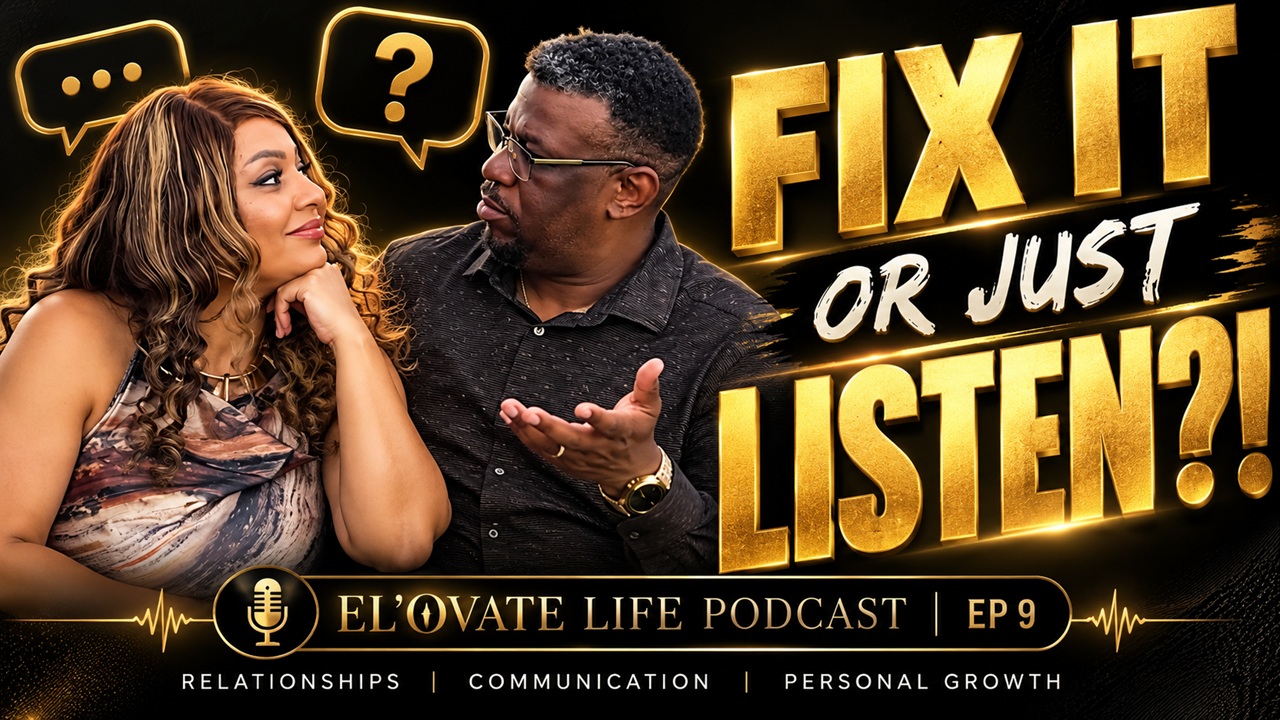
Do You Want My Advice or Just Want Me to Listen? How to Improve Communication in Relationships
By Rodney & Dr. Renata Robinson | EL’OVATE LIFE PODCAST — Episode 9 | JourneyUpTV
Sometimes the greatest gift you can give someone isn’t a solution. It’s the feeling of being heard.
Have you ever come home after a difficult day, hoping to share your frustrations with someone you love, only to get a list of suggestions on how to fix everything?
Before you even finish explaining what happened, they’re already offering solutions.
And you’re thinking, I didn’t ask you to fix it. I just wanted you to listen.
On the other side of that conversation is someone who genuinely believes they’re helping. They hear a problem, recognize a possible solution, and want to make things better.
Neither person necessarily has bad intentions.
Yet both can leave the conversation feeling misunderstood.
This is one of the most common challenges in relationship communication: understanding the difference between offering advice and providing emotional support.
In Episode 9 of the EL’OVATE LIFE PODCAST, we explore a question that applies to marriages, friendships, parenting, and even leadership:
Do you want my advice, or do you just want me to listen?
Why Do We Feel the Need to Fix Everything?
When someone we love experiences a problem, our first instinct may be to help solve it.
We want to protect them, ease their frustration, or keep them from unnecessary pain.
But here’s the challenge: what we consider helpful may not be what the other person needs at that moment.
Sometimes the person sharing their experience has already considered the available solutions.
They may not be asking for a strategy. They may simply need an opportunity to process their emotions.
Consider this example.
Your spouse comes home and says, “I’m so tired of dealing with these people at work!”
You immediately respond with suggestions to speak to a supervisor, document the situation, or approach the problem differently.
Your advice might be perfectly reasonable.
But what if your spouse simply wanted to hear:
“That sounds frustrating. Tell me what happened.”
The difference isn’t necessarily in how much you care.
It’s in how you demonstrate that care.
Listening Is Not the Absence of Helping
One of the most important lessons we can learn is that listening itself can be an act of support.
You don’t always have to provide the answer.
You don’t always have to make the situation better immediately.
Sometimes, being fully present is exactly what the other person needs.
And when someone feels understood, they may become more open to discussing possible solutions.
Are You Listening to Understand or Listening to Respond?
Think about your most recent difficult conversation.
Were you genuinely trying to understand the other person’s perspective?
Or were you mentally preparing your response while they were still speaking?
There’s a meaningful difference.
Listening to respond focuses on what you’re going to say next.
Listening to understand focuses on what the other person is trying to communicate.
When we listen only to respond, we may miss the emotions, concerns, and deeper meaning behind someone’s words.
But intentional listening requires patience, curiosity, and a willingness to hear something without immediately correcting it.
Five Ways to Become a Better Listener
- Give your full attention. Put away distractions and focus on the person speaking.
- Allow them to finish. Resist the urge to interrupt with your own experience or solution.
- Ask clarifying questions. Try asking, “What was the hardest part of that experience for you?”
- Acknowledge their feelings. You can recognize someone’s frustration without agreeing with every conclusion.
- Ask before offering advice. Find out whether they want your perspective before sharing it.
These small changes can make a meaningful difference in how people experience their conversations with you.
Listening Doesn’t Mean You Have to Agree
Here’s something important.
Understanding someone doesn’t require agreeing with everything they say.
You can listen compassionately and still see the situation differently.
You can validate someone’s emotions without validating every decision.
And you can respectfully disagree without dismissing their experience.
For example, instead of saying:
“You’re looking at this completely wrong.”
Consider saying:
“I understand why you feel that way. Would you be open to hearing another perspective?”
The second response creates an opportunity for dialogue rather than defensiveness.
The goal isn’t to win the conversation.
The goal is to understand the person while creating room for honest communication.

Fix It or Feel It? Real-Life Relationship Scenarios
One of the most engaging parts of Episode 9 is our discussion of situations where we have to decide whether to offer solutions, listen, or ask a question first.
Scenario 1: Your Spouse Has a Terrible Day
Your spouse comes home visibly frustrated.
Do you immediately offer solutions?
Or do you ask what kind of support would be most helpful?
The intentional approach: Begin with empathy. Ask whether they want to talk through solutions or simply share what happened.
Scenario 2: Your Adult Child Makes a Mistake
Your adult child comes to you and says, “I think I made a huge mistake.”
As a parent, your instinct may be to protect them.
But parenting adult children often requires a different kind of support.
There are times to offer guidance, and there are times to allow them to work through their own decisions.
The intentional approach: Listen first, understand the situation, and determine whether your child wants advice, reassurance, or help thinking through the next step.
Scenario 3: A Friend Keeps Repeating the Same Problem
Your friend has called you five times about the same relationship issue.
You’ve offered advice repeatedly, but nothing changes.
What do you do on call number six?
This is where listening and boundaries must work together.
You can care about someone without taking responsibility for every problem they experience.
The intentional approach: Offer compassion while being honest about your emotional capacity and the limits of your involvement.
Scenario 4: Someone You Love Is Making a Harmful Decision
What happens when someone you care about is preparing to make a decision that could seriously hurt them?
Should you remain silent simply because they haven’t requested advice?
Not necessarily.
Sometimes speaking up is an important expression of love and concern.
The key is approaching the conversation with humility, respect, and an understanding that you cannot control another person’s choices.
Communication Matters Beyond Marriage
Although these conversations often occur between romantic partners, intentional listening affects nearly every relationship.
Parenting: Guidance Without Control
As our children grow into adulthood, our role changes.
We can share wisdom and experience while recognizing their growing responsibility to make decisions.
Listening helps create space for that independence.
Friendships: Support Without Ownership
Being a good friend doesn’t require carrying every burden.
Healthy friendships allow room for honesty, encouragement, and boundaries.
Remember: someone sharing a problem with you doesn’t automatically make it your responsibility to solve.
Leadership: Understanding Before Acting
Leaders face a similar challenge.
When an employee shares a concern, it’s tempting to immediately identify the problem and implement a solution.
But sometimes the first step toward effective leadership is understanding what the person is experiencing.
Asking thoughtful questions can uncover information that might otherwise be missed.
People are more likely to feel valued when they believe their perspectives have been genuinely considered.
Three Questions That Can Transform Your Conversations
If you take nothing else away from this conversation, consider adding these three questions to your everyday communication.
1. “Do You Want Me to Listen, or Do You Want My Perspective?”
This simple question helps clarify expectations.
It communicates that you’re willing to support the person without assuming what they need.
2. “What Would Support Look Like for You Right Now?”
We sometimes offer the kind of support we would want rather than the support someone else needs.
This question invites the other person to explain what would actually help.
3. “Would You Like to Hear Another Way of Looking at This?”
Even helpful advice can feel like criticism when it arrives at the wrong moment.
Asking permission before sharing another perspective can make the conversation more collaborative.
These questions don’t guarantee perfect communication.
But they can help reduce unnecessary misunderstandings.
The Other Side of Communication: Stop Expecting People to Read Your Mind
Listening is only half of the equation.
The person sharing their experience also has a responsibility to communicate clearly.
We cannot always expect someone to know whether we need advice, encouragement, or emotional support.
Sometimes the most effective thing we can say is:
“I just need to vent for a few minutes.”
Or:
“I’d really appreciate your perspective on this.”
Or even:
“Can you help me figure out what to do next?”
Healthy communication requires both people to participate intentionally.
One person learns to listen without immediately assuming.
The other learns to express their needs without expecting mind-reading.
That is how understanding begins to replace unnecessary frustration.
The EL’OVATE Challenge: Listen With Intention
Here’s a challenge you can put into practice this week.
During your next meaningful conversation, resist the urge to immediately offer advice.
Instead, ask:
“What do you need from me right now?”
Then listen carefully to the answer.
You might discover that the person doesn’t need you to solve anything.
They simply need to know you’re present.
And if you’re the one sharing your frustrations, challenge yourself to clearly communicate what kind of support you’re seeking.
The goal isn’t to become a perfect communicator overnight.
The goal is to become more intentional with every conversation.
Final Thoughts: Sometimes Love Needs to Listen Deeper
Relationships don’t grow stronger simply because we have all the right answers.
They grow through patience, understanding, mutual respect, and the willingness to communicate openly.
Sometimes the greatest expression of love is offering wisdom.
Other times, it’s offering silence, attention, and a listening ear.
The real challenge is learning to recognize the difference.
Sometimes love doesn’t need to speak louder. It needs to listen deeper.
Watch EL’OVATE LIFE PODCAST — Episode 9
Join Rodney and Dr. Renata Robinson for a relatable conversation about listening, emotional support, communication, and intentional relationships.
Episode: Do You Want My Advice, or Do You Just Want Me to Listen?
Watch on JourneyUpTV: https://www.youtube.com/watch?v=xSl5HIvi0DU
Join the Conversation
Are you naturally the FIXER or the LISTENER?
And what is one thing you wish people understood about how you communicate?
Share your perspective in the comments and continue the conversation with us.
EL’OVATE YOUR JOURNEY
Empower. Elevate. Succeed.
Leave a Reply